
The State of Counselling in 2026
ISPC Professional Insights | October 2026
The Changing Landscape of Counselling in 2026: A Profession at a Turning Point
Counselling and psychotherapy are entering a period of significant change. As 2026 draws towards its conclusion, the profession is responding to substantial mental health needs, evolving client expectations, new technologies and growing demands for professional accountability.
Across the United Kingdom and internationally, psychological wellbeing is increasingly recognised as an essential component of public health, workplace sustainability and community resilience. Yet greater recognition does not automatically mean that appropriate therapeutic support is accessible to everyone who needs it.
For counsellors, psychotherapists, supervisors, educators and those entering the profession, the question is no longer simply whether counselling has an important future. It is how the profession can develop responsibly while maintaining the therapeutic relationship at the heart of practice.
The Numbers Behind Mental Health Demand
Recent published statistics demonstrate the scale of the challenge. These figures describe different populations and reporting periods, but together illustrate why access to psychological support remains a major concern.
NHS England also reported that 91.6% of referrals completing a course of treatment accessed NHS Talking Therapies within six weeks in 2024/25. The proportion moving to recovery was 50.5%. These measures provide valuable insight into service performance, although they do not represent the outcomes of every person referred.
Importantly, the 1.81 million referral figure was slightly lower than the previous year’s 1.83 million. It would therefore be inaccurate to describe every indicator as showing uninterrupted annual growth. The broader picture is one of substantial demand, alongside changing patterns of access and provision.
Workplace Mental Health: An Expanding Area of Need
The Health and Safety Executive estimated that 964,000 workers in Great Britain experienced work-related stress, depression or anxiety during 2024/25. These conditions accounted for approximately 22.1 million working days lost.
These figures are not a direct measurement of demand for counselling. Nevertheless, they demonstrate why organisations are paying increasing attention to psychological wellbeing, early intervention, supportive management and appropriate routes to professional help.
What Does Growth Mean for Counsellors?
A larger conversation about mental health creates potential opportunities across private practice, education, charitable organisations, healthcare, employee assistance programmes and community services. However, rising need should not be confused with guaranteed employment, increasing practitioner earnings or a uniformly expanding counselling workforce.
The UK counselling and psychotherapy workforce includes practitioners with different qualifications, professional memberships and employment arrangements. There is no single comprehensive workforce count that captures every practitioner across every setting. Membership totals from individual professional bodies should not be treated as the total number of practising therapists.
ISPC Perspective: The future of counselling must be measured by more than the number of people seeking support. Professional competence, ethical accountability, equitable access and the quality of the therapeutic relationship are equally important.
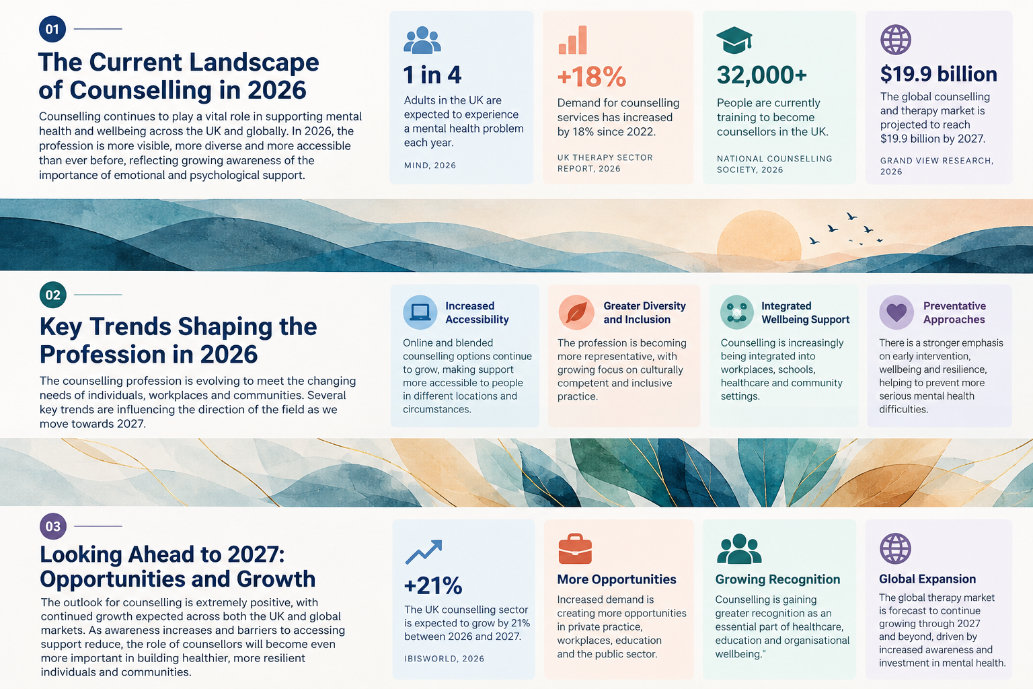
Part Two | Emerging Therapeutic Trends
From Traditional Counselling to a More Diverse Therapeutic Landscape
The counselling profession is becoming increasingly diverse in how therapeutic support is delivered, the needs practitioners encounter and the specialist knowledge required to work responsibly.
Rather than a single therapeutic approach replacing all others, 2026 is characterised by greater discussion of integration, accessibility, cultural responsiveness and the relationship between evidence-based practice and individual client needs.
1. Online and Hybrid Counselling
Remote therapy has become an established part of the wider therapeutic landscape. Video sessions and other appropriately governed remote formats can improve access for people facing geographical, mobility, caring or scheduling barriers.
NHS Talking Therapies recorded 500,034 sessions of internet-enabled therapy in 2024/25. This was a decrease of 5.7% from the preceding year, demonstrating that digital provision should not automatically be described as growing in every service or reporting period.
For practitioners, remote work raises important considerations around confidentiality, client identity, emergency procedures, digital security, accessibility and suitability for individual needs.
2. Trauma-Informed and Trauma-Focused Practice
Trauma-informed principles continue to influence conversations about therapeutic safety, trust, choice, collaboration and empowerment. Practitioners increasingly need to consider how previous adversity may affect engagement, relationships and responses to treatment.
Trauma-informed working is not the same as delivering specialist trauma treatment. Approaches such as EMDR and trauma-focused CBT require appropriate training, competence and careful assessment of suitability.
3. Neurodiversity-Affirming Counselling
Greater attention is being given to how counselling environments and therapeutic communication can better accommodate autistic people, people with ADHD and other neurodivergent clients.
This may involve adapting communication, considering sensory needs, offering clearer expectations and avoiding assumptions about how emotional distress should be expressed.
Neurodiversity-affirming practice should be grounded in individual assessment and client preferences rather than a single approach assumed to suit everyone.
4. Integrative and Pluralistic Approaches
The profession continues to encompass person-centred, psychodynamic, cognitive behavioural, humanistic, systemic and integrative traditions, among others.
Integrative and pluralistic practice offers opportunities to consider different therapeutic perspectives in response to client needs. However, combining methods responsibly requires a coherent rationale, suitable training and awareness of the evidence supporting particular interventions.
5. Workplace Wellbeing and Preventative Support
Workplace mental health is an important area of professional discussion. Organisations may seek support through employee assistance programmes, occupational health provision, wellbeing education and counselling referrals.
Effective workplace mental health provision should also address organisational causes of distress, including workload, management practices and working conditions. Counselling must not become a substitute for employers meeting their wider responsibilities.
6. Artificial Intelligence and Digital Ethics
Artificial intelligence is introducing new possibilities for administration, education, accessibility and professional reflection. It also creates substantial questions about accuracy, informed consent, data protection, bias and clinical accountability.
AI-generated information should not be confused with a qualified therapeutic relationship. Practitioners remain responsible for professional judgement, confidentiality, risk assessment and the safe management of client information.
The International Society of Psychotherapy and Counselling recognises the importance of clear ethical standards when emerging technologies are considered within professional practice.
The central trend: Counselling is not simply moving towards more technology or greater specialisation. It is moving towards a more complex environment in which practitioners must combine clinical competence, adaptability and ethical judgement.

Part Three | Looking Towards 2027
The Future of Counselling: Opportunities, Responsibilities and Professional Growth
As the profession approaches 2027, its future will be shaped not only by demand for psychological support but by the standards, skills and values that underpin its delivery.
There are reasons for optimism. Mental health occupies a prominent place in public discussion, therapeutic services operate across a wide range of settings, and practitioners have opportunities to develop specialist knowledge. Yet important challenges remain.
Five Priorities Likely to Shape 2027
1. Accessible and Equitable Counselling
Improving access will remain a significant challenge. Affordability, location, disability, cultural barriers and service capacity can all affect whether individuals receive appropriate support.
Future development should consider both the availability of counselling and whether services are responsive to the communities they intend to serve.
2. Stronger Professional Standards
Clients should be able to understand a practitioner’s qualifications, professional standing, scope of competence and accountability arrangements.
Clear ethical frameworks, appropriate supervision, continuing professional development and transparent professional information will remain essential.
3. Specialist Knowledge and Lifelong Learning
Practitioners may increasingly seek additional education in areas such as trauma, neurodiversity, bereavement, relational difficulties, digital practice and culturally responsive counselling.
Specialisation should follow suitable training and supervised experience, rather than marketing claims or short courses that exceed their educational scope.
4. Responsible Technology Adoption
Digital tools may assist with administrative efficiency and access to information. Their use must be assessed against confidentiality obligations, applicable data protection law and professional responsibilities.
As technology evolves, professional organisations will have an important role in encouraging informed debate and practical ethical guidance.
5. Practitioner Wellbeing and Sustainability
The wellbeing of counsellors and psychotherapists deserves sustained attention. Emotional demands, isolation, financial pressures and complex client presentations can affect professional sustainability.
Good supervision, peer connection, manageable workloads and reflective practice are important foundations for safe and sustainable therapeutic work.
Will the Counselling Profession Continue to Grow?
The underlying need for effective mental health support suggests that counselling and psychotherapy will continue to play important roles in healthcare, education, employment and community life.
However, the precise rate of workforce expansion, private practice growth and practitioner earnings in 2027 cannot reliably be established from the statistics presented here.
Future growth will depend on factors including public investment, service commissioning, training opportunities, workforce retention, household finances and developments in professional standards.
The Role of ISPC in a Changing Profession
The International Society of Psychotherapy and Counselling (ISPC) is committed to supporting professional identity, ethical awareness and the ongoing development of counselling and psychotherapy.
As practice becomes more diverse and technologically complex, professional communities can offer valuable opportunities for connection, reflection and continued learning.
For students and established practitioners alike, professional membership can form part of a wider commitment to responsible practice and continuing development.
Looking ahead: The defining question for 2027 may not be how quickly counselling expands, but how effectively the profession responds to changing needs while protecting the standards and human relationships on which therapeutic work depends.
Conclusion: Growth with Purpose
The counselling landscape of 2026 presents a profession with considerable relevance and responsibility. Mental health needs remain substantial, therapeutic delivery continues to evolve, and practitioners face new opportunities alongside complex ethical challenges.
Moving into 2027, sustainable progress will depend on accessible services, credible education, professional accountability, appropriate supervision and a continuing commitment to client-centred care.
The future of counselling should not be defined by growth alone. It should be defined by the quality, integrity and humanity of the support offered.
Be Part of the Future of Counselling
Discover the International Society of Psychotherapy and Counselling and explore professional membership opportunities.
Explore ISPC →Editorial note: Published figures refer to their stated reporting periods. The outlook for 2027 represents professional analysis rather than a statistical forecast.
Published October 2026 | International Society of Psychotherapy and Counselling
Further Resources for ISPC Members:
What Happens in a Typical Counselling Session?
Counsellor Red Flags: What to Watch Out For
Therapeutic Models of Counselling
We encourage all ISPC members and non-members to consider contributing to ISPC News and sharing their unique perspectives and insights. Your contributions help build a valuable resource for the therapy and counselling community.
And lastly, we appreciate those that have already come forward with their ideas and writings, we are uploading these blogs over the next few weeks and months.
Kindest Regards
ISPC Team